
The Evolution of New Year's Celebrations
Here's something most people don't think about when they're counting down to midnight: why January 1st? I mean, it's literally the middle of winter in most of the Northern Hemisphere. Nothing is blooming, nothing is being harvested. It seems like a weird time to start a new year, right?
Well, turns out the story of how we ended up celebrating New Year on January 1st is pretty wild, involving everything from ancient Babylonian parties to a pope who was really bothered by calendar math.
When Did People Actually Start Celebrating New Year?
The Babylonians were probably the first to make a big deal about it, around 4,000 years ago. But get this - they celebrated in late March, during the spring equinox. Which actually makes way more sense when you think about it. Spring meant crops were growing again, the world was literally coming back to life after winter. That feels like a natural "new beginning."
They called it Akitu, and it wasn't just a one-night party. This thing went on for 11 days. There were religious ceremonies for their main god Marduk, the king would basically have his job performance reviewed by the gods (imagine that on your calendar), and of course, lots of feasting. The ancient world knew how to party.
The Egyptians had their own take on it. They pegged their new year to the Nile's annual flood, which happened around mid-July. That flood was literally everything to them - it brought the rich soil that let them grow food. So yeah, that was their "new year." The flood comes, the year begins. Simple, practical, makes sense.
So How Did We End Up With January 1st?
This is where the Romans come in, and they made a mess of things before they fixed it.
Originally, the Roman calendar only had 10 months. Seriously. It started in March and ended in December (which literally means "tenth month" - that's why September, October, November, December have "sept," "oct," "nov," "dec" in them, meaning 7th, 8th, 9th, and 10th). The Romans just... didn't count the winter months. They were basically like, "Eh, nothing's happening in winter anyway."
Eventually someone realized this was causing problems, so they added January and February. But March was still the first month for a long time.
Then Julius Caesar got involved. In 46 BCE, he hired some astronomers (well, the ancient equivalent) to redesign the whole thing. They created what we now call the Julian calendar, and Caesar decided to move New Year to January 1st. The reason? That was the day Roman consuls traditionally took office. Also, January was named after Janus, the two-faced god who looks backward and forward at the same time - perfect symbolism for a new year, right?

Medieval Europe: Complete Calendar Chaos
Here's where things get really messy. During the Middle Ages, different parts of Europe celebrated New Year on completely different dates.
England used March 25 until 1752. France and other places used Easter for a while (which moves around every year - imagine that headache). Some Germanic regions used Christmas. Historians have a nightmare trying to figure out what year medieval documents are actually from because nobody could agree when the year started.
It wasn't until 1582 that Pope Gregory XIII introduced the Gregorian calendar (that's the one we still use) and said, "Okay everyone, January 1st, final answer." Of course, it took centuries for everyone to actually adopt it. Britain and its colonies didn't switch until 1752, and some countries held out even longer.
New Year Celebrations Around the World
What's interesting is that while a lot of the world now recognizes January 1st as New Year (thanks to the Gregorian calendar's spread), many cultures maintained their traditional New Year celebrations based on their own calendars.
Chinese New Year is probably the most famous alternative. It follows the lunar calendar, so it moves around between late January and mid-February. And when I say it's a big deal, I mean it's THE big event. We're talking about the largest annual human migration on Earth as people travel home for the celebration. The traditions are elaborate - red envelopes with money, massive fireworks displays, dragon dances, thorough house cleaning to sweep out bad luck. It lasts for days, not just one night.
Nowruz, the Persian New Year, happens on the spring equinox around March 20. It's been celebrated for over 3,000 years across Iran, Afghanistan, Central Asia, and Kurdish regions. People set up this thing called a "Haft-Seen" table with seven items starting with the Persian letter S, each symbolizing something like health, wealth, or patience. It's actually recognized by the UN as an international holiday now.
Rosh Hashanah, the Jewish New Year, usually falls in September or early October. Unlike the party-heavy celebrations you might be used to, this one is more introspective - it's about reflection and new beginnings in a spiritual sense. The shofar (a ram's horn) is blown, people eat apples dipped in honey hoping for a sweet year ahead, and there's serious time spent in prayer and contemplation.

The Weird and Wonderful: New Year Traditions That Will Surprise You
Some New Year traditions are just... well, let me share a few that always make me smile:
In Spain, people scramble to eat 12 grapes in the 12 seconds of the clock striking midnight. One grape per bell. It's way harder than it sounds, and watching people try it on TV is hilarious. Miss the rhythm and you're supposed to have bad luck all year. No pressure.
The Danes have this tradition of smashing plates against their friends doors. The more broken dishes you find on your doorstep on New Year's Day, the more friends you have. I mean, it's sweet, but also... imagine the cleanup.
In Scotland, there's "first-footing" - the first person to enter your home after midnight brings symbolic gifts: whisky for good cheer, bread so you never go hungry, salt for wealth, and coal to keep the house warm. Apparently tall, dark-haired men are the luckiest first-footers. Short blonde guys, you're out of luck.
My personal favorite: in Colombia, people run around the block with empty suitcases. Why? To ensure a year full of travel. It's both ridiculous and kind of genius.
The Times Square Ball Drop: An Accidental Tradition
Since we're talking about modern celebrations, let's address the big one: the Times Square ball drop in New York City.
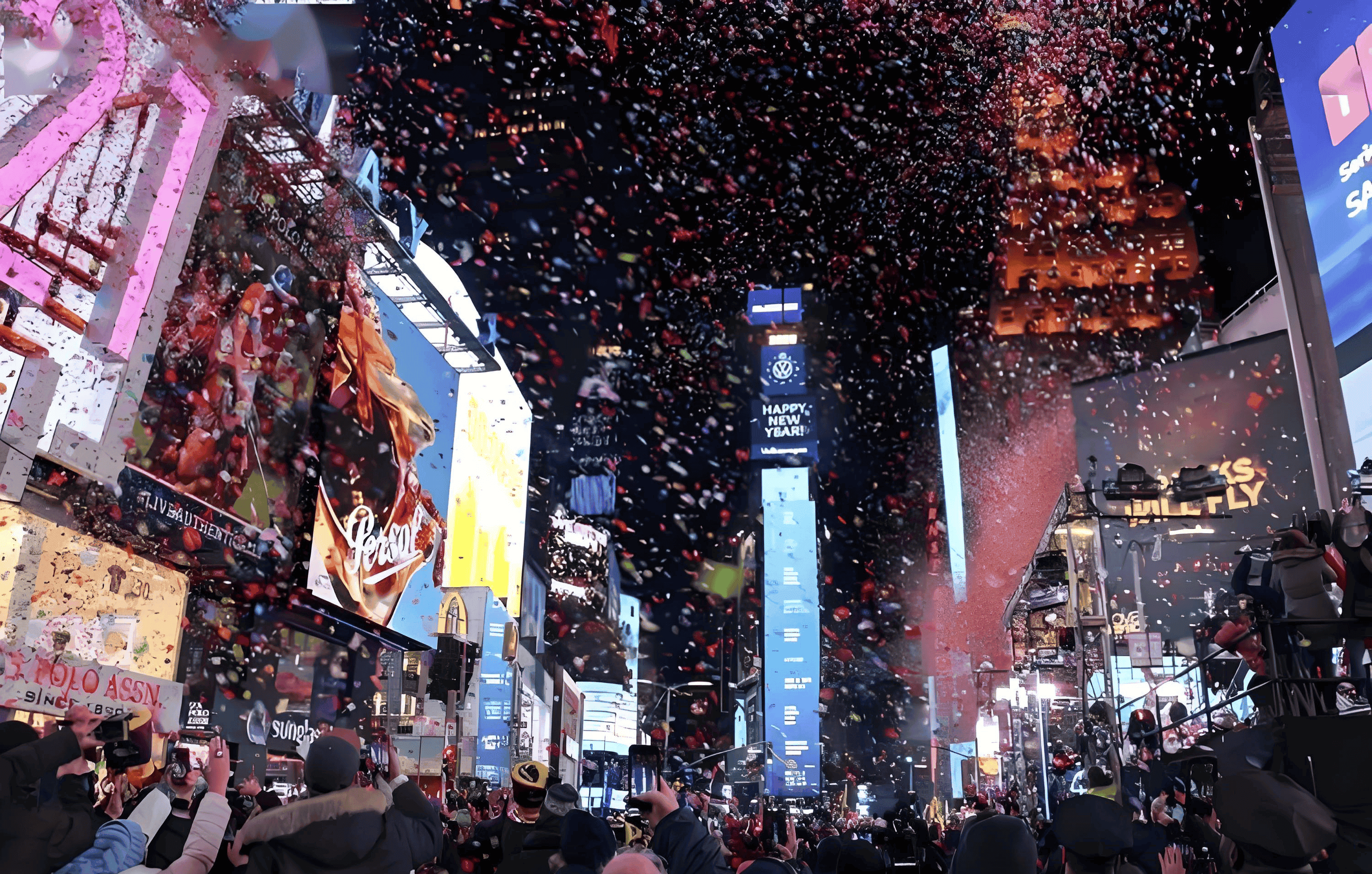
This started in 1907, and honestly, it was kind of a backup plan. The city had just banned fireworks in Times Square (too dangerous, go figure), and the newspaper owners needed something to mark midnight for their New Year's Eve party. Someone suggested dropping a lit ball from the top of the building. And somehow, this became one of the most iconic New Year traditions in the world.
The current ball weighs nearly 12,000 pounds and is covered in Waterford crystals. Over a billion people watch it drop worldwide. A billion. For a ball that drops 77 feet in 60 seconds. But hey, tradition is tradition.

New Year Resolutions: Why Do We Do This to Ourselves?
Ah yes, resolutions. That annual tradition of promising to completely transform your life and then giving up by February.
The concept actually goes back to those Babylonians we talked about earlier. They would promise their gods to return borrowed farming equipment and pay their debts. Seems more practical than "lose 20 pounds" or "go to the gym five times a week."
Modern research shows that only about 8% of people actually achieve their New Year resolutions. That's pretty dismal. The problem usually isn't lack of motivation - it's that we set these vague, ambitious goals without any real plan.
"Get healthier" means nothing. "Go to the gym every Monday, Wednesday, and Friday at 7 AM" - that's something you can actually track and do. The successful resolutions are specific, realistic, and measurable. But that's less exciting than declaring you're going to become a completely different person, right?

How Technology Changed Everything
The way we celebrate New Year has shifted dramatically with technology. My parents tell stories about gathering around the TV to watch the ball drop together - it was event television. Now people are on their phones live-streaming parties from six different time zones simultaneously.
You can literally follow New Year around the world. Watch Sydney fireworks, then Dubai, then Moscow, then London, then finally New York. It's kind of amazing when you think about it. The whole world celebrating the same thing, just 24 hours apart.
Video calls mean you're not really separated from family anymore on New Year's Eve. Sure, it's not the same as being there in person, but it's something our grandparents couldn't even imagine.
Though I do miss the simplicity sometimes. There's something about a thousand people watching their phones at a party that feels a bit sad.

Some Random New Year Facts I Cannot Resist Sharing
About 360 million glasses of champagne are consumed worldwide on New Year's Eve. That's a lot of bubbly.
Sydney, Australia is usually one of the first major cities to ring in the New Year. Their fireworks show over the harbor is absolutely spectacular - if you ever get a chance to see it in person, do it.
The song "Auld Lang Syne" that everyone sings at midnight? Most people do not know the words beyond the first line. It's Scottish, written by Robert Burns in 1788, and it basically means "times long past" or "old times sake." We're all singing about remembering old friends, but let's be honest - mostly we're just going "should old acquaintance be forgot... and something something... for auld lang syne."
Why This All Actually Matters
Look, New Year is arbitrary. There's nothing cosmically significant about January 1st at midnight. The Earth doesn't care. The universe doesn't reset.
But humans need markers. We need moments to stop, reflect, and decide to do better. The New Year gives us that. It's permission to start fresh, to forgive ourselves for last year's failures, to hope that this time will be different.
Every culture that has ever existed has had some version of this - some way of marking time's passage and celebrating survival and continuity. Whether it's the Babylonian spring festival or watching a crystal ball drop in Times Square, we're all doing the same thing: acknowledging that time moves on, and choosing to move with it hopefully.
So this New Year, whether you're eating 12 grapes, smashing plates, jumping waves in white, or just watching Netflix until you accidentally fall asleep before midnight (no judgment), you're part of a tradition that goes back thousands of years.
And that's actually pretty cool when you think about it.
Happy New Year from all of us at HistAI.
Want to dive deeper into historical traditions and celebrations? Check out more stories at histai.net - where we make history actually interesting.